> ## Documentation Index
> Fetch the complete documentation index at: https://docs.somark.cn/llms.txt
> Use this file to discover all available pages before exploring further.
# Using SoMark in Dify
> Add SoMark Document Parser to your Dify workflows via the plugin marketplace
## Install and Configure the Plugin
Log in to your Dify platform, navigate to **Tools** → **Plugin Marketplace**, search for **SoMark**, and add the plugin.
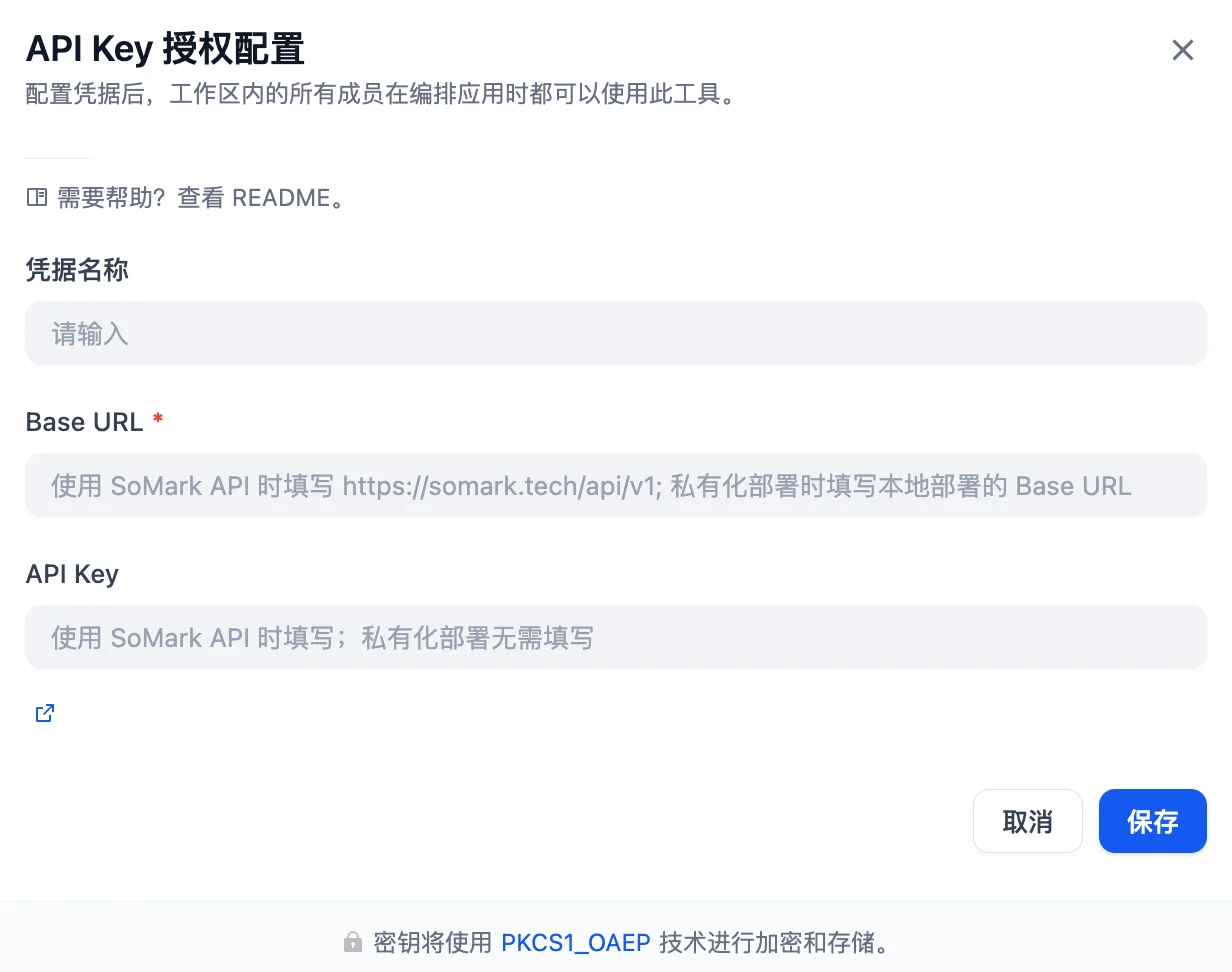
After installation, open the plugin configuration page:
* **Base URL**: For SoMark API, fill in `https://somark.tech/api/v1`; for self-hosted deployment, fill in your local Base URL.
* **API Key**: Required for SoMark API; leave blank for self-hosted deployment.
No API Key yet? [Go to the SoMark workbench to claim free quota](https://somark.tech/workbench/purchase).
The Dify plugin runtime must be able to access the configured **Base URL**. Check your network, proxy, and DNS settings. Do not append a specific endpoint path to **Base URL**; the plugin will call the corresponding endpoint automatically.
Click **Save** — the plugin is now ready to use in workflows.
 ***
## Using SoMark in a Workflow
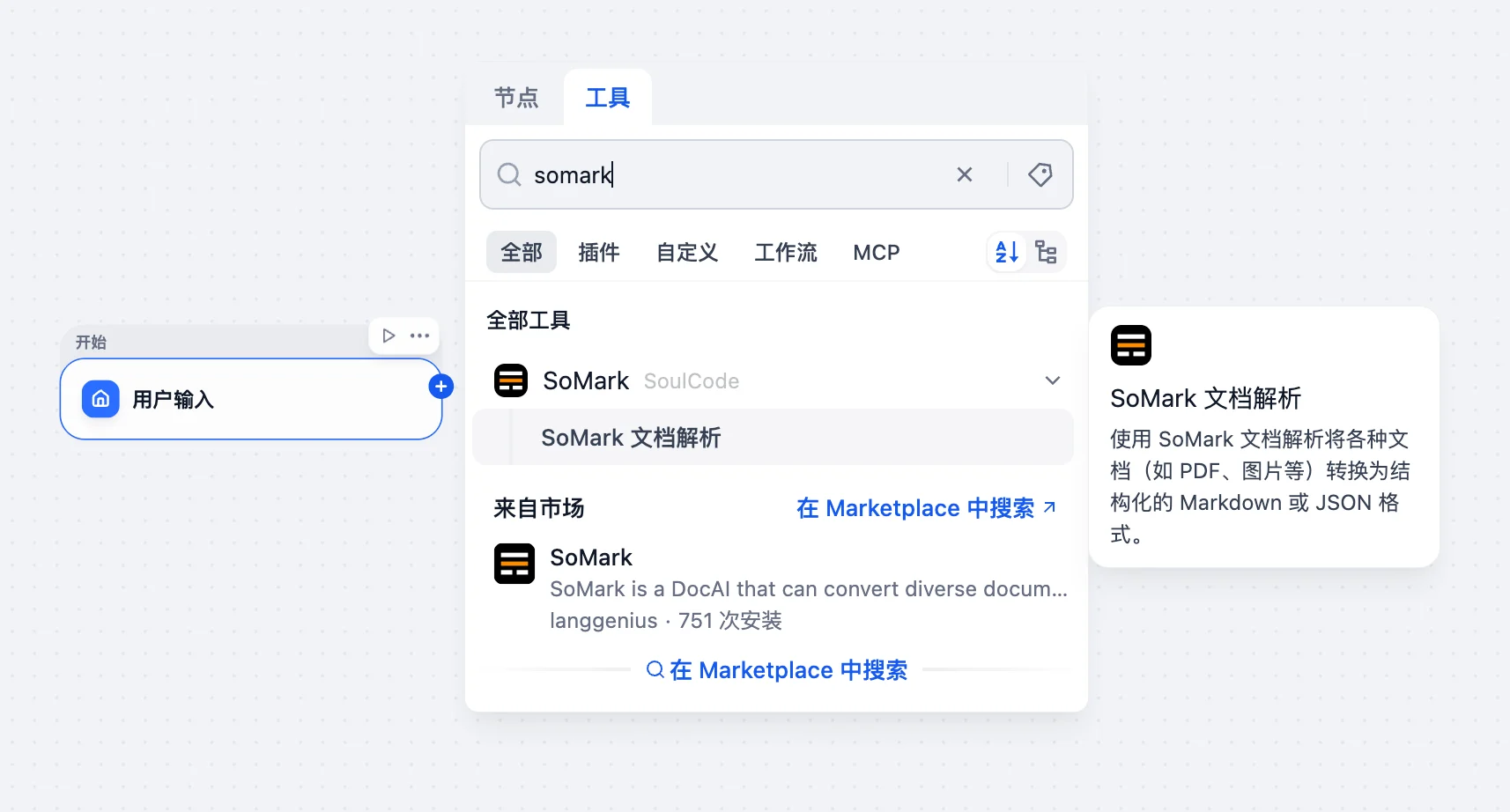
In the Dify workflow editor, click **+** to add a new node, choose **Tool**, then find and add the **SoMark > SoMark Document Parser** node.
***
## Using SoMark in a Workflow
In the Dify workflow editor, click **+** to add a new node, choose **Tool**, then find and add the **SoMark > SoMark Document Parser** node.
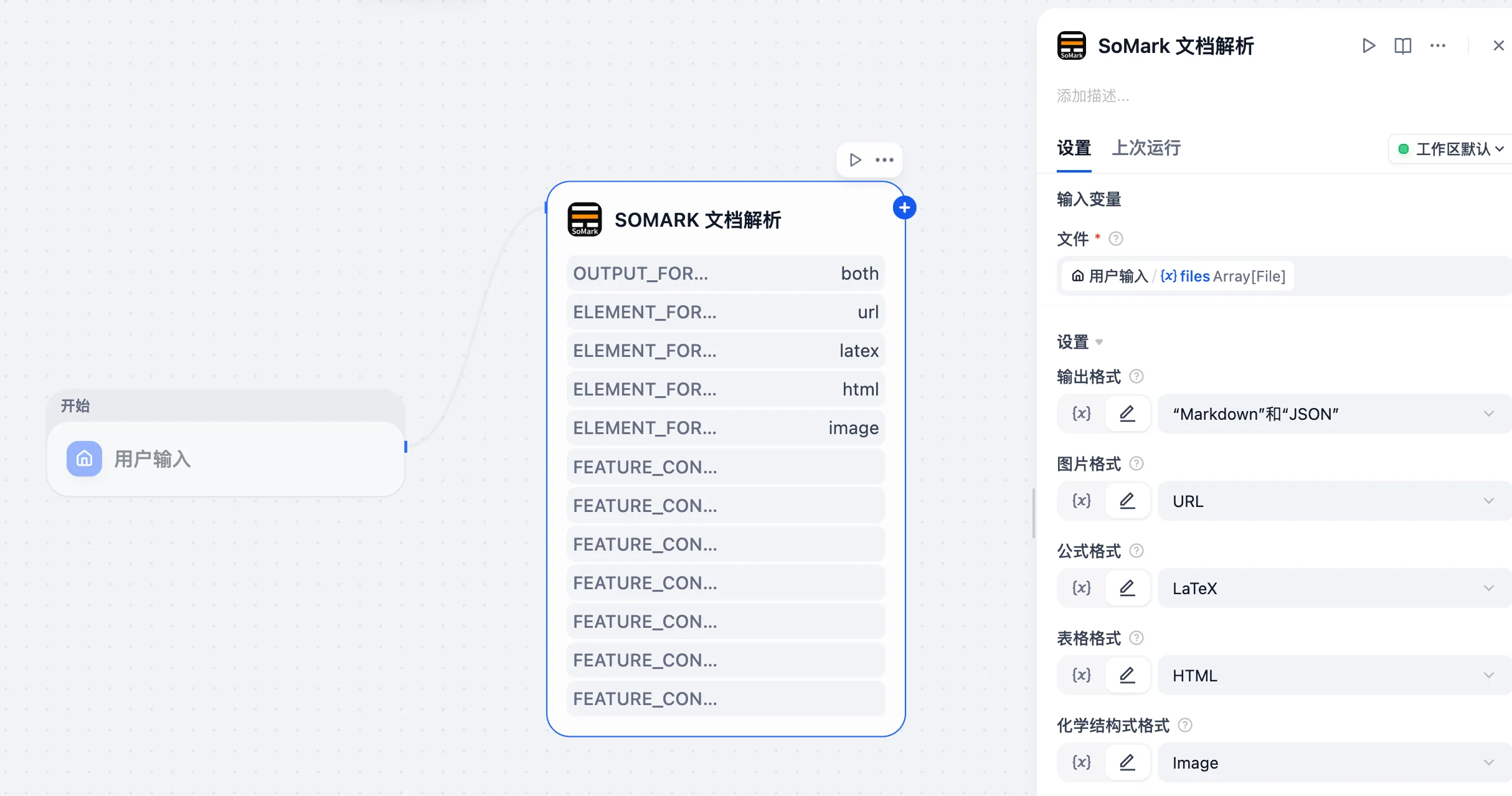
 Click the variable icon **`{x}`** in the **File** input field and select the file variable provided by an upstream node, such as `sys.files` from your Start node.
You can also configure optional parameters (for example **Output Formats**, **Image Format**, **Table Format**) as needed. If left empty, the default values are used. See **Input Parameters** below for details.
**Base URL** and **API Key** are injected automatically from the plugin configuration. You do not need to enter them in the node.
Click the variable icon **`{x}`** in the **File** input field and select the file variable provided by an upstream node, such as `sys.files` from your Start node.
You can also configure optional parameters (for example **Output Formats**, **Image Format**, **Table Format**) as needed. If left empty, the default values are used. See **Input Parameters** below for details.
**Base URL** and **API Key** are injected automatically from the plugin configuration. You do not need to enter them in the node.
 Once the node executes, its output variables are available to all downstream nodes (LLM, text splitter, code node, etc.). Click **`{x}`** in any downstream node's input field to select the SoMark node's output variables.
***
## Parameters and Outputs
### Input Parameters
| Parameter | Type | Required | Description |
| :---------------------------------- | :------------ | :------- | :------------------------------------------------------------------------------------------------------------------------------------------------------------------------------- |
| `File` | File | ✅ | Supported files: PDF, PNG, JPG, JPEG, BMP, TIFF, JP2, DIB, PPM, PGM, PBM, GIF, HEIC, HEIF, WEBP, XPM, TGA, DDS, XBM, DOC, DOCX, PPT, PPTX. Max 200 MB / 300 pages. |
| `Output Formats` | Single-select | ❌ | Select the output format. Supported options: `Markdown`, `JSON`, `Both "Markdown" and "JSON"`. Default: `Both "Markdown" and "JSON"`. |
| `Image Format` | Single-select | ❌ | Image output format. Supported options: `URL`, `Base64`, `None`. Default: `URL`. |
| `Formula Format` | Single-select | ❌ | Formula output format. Supported options: `LaTeX`, `MathML`, `ASCII`. Default: `LaTeX`. |
| `Table Format` | Single-select | ❌ | Table output format. Supported options: `HTML`, `Markdown`, `Image`. Default: `HTML`. In Markdown mode, merged cells are expanded into individual cells with duplicated content. |
| `Chemical Structure Formula Format` | Single-select | ❌ | Chemical structure output format. Supported options: `Image`. Default: `Image`. |
| `Enable Text Cross Page` | True / False | ❌ | Merge text that spans across pages into a continuous paragraph. Default: `False`. |
| `Enable Table Cross Page` | True / False | ❌ | Merge tables that span across pages into a continuous table. Default: `False`. |
| `Enable Title Level Recognition` | True / False | ❌ | Recognize heading hierarchy such as H1/H2/H3. Default: `False`. |
| `Enable Inline Image` | True / False | ❌ | Return images embedded in text paragraphs. Default: `False`. |
| `Enable Table Image` | True / False | ❌ | Return images embedded in table cells. Default: `True`. |
| `Enable Image Understanding` | True / False | ❌ | Perform semantic understanding and structured description for images in the document. Default: `True`. |
| `Keep Header Footer` | True / False | ❌ | Keep page headers and footers instead of filtering them out. Default: `False`. |
### Output Variables
| Variable | Description |
| ---------- | -------------------------------------------------------------------------------------------------------------------------------------------------------------------------------------------- |
| `markdown` | Parsed document content in Markdown format, preserving the original layout including headings, tables, lists, equations, and images |
| `json_str` | Parsed result as a JSON string, containing structured data such as text blocks, tables, equations, images, bounding boxes, and page numbers. Parse it in a code node for advanced processing |
| `text` | Dify built-in variable. This plugin does not populate it |
| `files` | Dify built-in variable. This plugin does not populate it |
Once the node executes, its output variables are available to all downstream nodes (LLM, text splitter, code node, etc.). Click **`{x}`** in any downstream node's input field to select the SoMark node's output variables.
***
## Parameters and Outputs
### Input Parameters
| Parameter | Type | Required | Description |
| :---------------------------------- | :------------ | :------- | :------------------------------------------------------------------------------------------------------------------------------------------------------------------------------- |
| `File` | File | ✅ | Supported files: PDF, PNG, JPG, JPEG, BMP, TIFF, JP2, DIB, PPM, PGM, PBM, GIF, HEIC, HEIF, WEBP, XPM, TGA, DDS, XBM, DOC, DOCX, PPT, PPTX. Max 200 MB / 300 pages. |
| `Output Formats` | Single-select | ❌ | Select the output format. Supported options: `Markdown`, `JSON`, `Both "Markdown" and "JSON"`. Default: `Both "Markdown" and "JSON"`. |
| `Image Format` | Single-select | ❌ | Image output format. Supported options: `URL`, `Base64`, `None`. Default: `URL`. |
| `Formula Format` | Single-select | ❌ | Formula output format. Supported options: `LaTeX`, `MathML`, `ASCII`. Default: `LaTeX`. |
| `Table Format` | Single-select | ❌ | Table output format. Supported options: `HTML`, `Markdown`, `Image`. Default: `HTML`. In Markdown mode, merged cells are expanded into individual cells with duplicated content. |
| `Chemical Structure Formula Format` | Single-select | ❌ | Chemical structure output format. Supported options: `Image`. Default: `Image`. |
| `Enable Text Cross Page` | True / False | ❌ | Merge text that spans across pages into a continuous paragraph. Default: `False`. |
| `Enable Table Cross Page` | True / False | ❌ | Merge tables that span across pages into a continuous table. Default: `False`. |
| `Enable Title Level Recognition` | True / False | ❌ | Recognize heading hierarchy such as H1/H2/H3. Default: `False`. |
| `Enable Inline Image` | True / False | ❌ | Return images embedded in text paragraphs. Default: `False`. |
| `Enable Table Image` | True / False | ❌ | Return images embedded in table cells. Default: `True`. |
| `Enable Image Understanding` | True / False | ❌ | Perform semantic understanding and structured description for images in the document. Default: `True`. |
| `Keep Header Footer` | True / False | ❌ | Keep page headers and footers instead of filtering them out. Default: `False`. |
### Output Variables
| Variable | Description |
| ---------- | -------------------------------------------------------------------------------------------------------------------------------------------------------------------------------------------- |
| `markdown` | Parsed document content in Markdown format, preserving the original layout including headings, tables, lists, equations, and images |
| `json_str` | Parsed result as a JSON string, containing structured data such as text blocks, tables, equations, images, bounding boxes, and page numbers. Parse it in a code node for advanced processing |
| `text` | Dify built-in variable. This plugin does not populate it |
| `files` | Dify built-in variable. This plugin does not populate it |